Fri 20 July – 7361 steps
David got up early and went for a cycle in the surrounding countryside, where they farm beans and maize intensively.


We left Vidalia and crossed the Mississippi river back into Natchez. We did a tour of one of the old antebellum mansions, Stanton hall. It was built in 1857, by an Irish immigrant, Frederick Stanton, who started as a cotton broker, but soon realized the money was in growing cotton, so he bought plantations as well. Clever man! Unfortunately he died 2 months after the house was completed, but his family continued to live there, except for a short period when it was occupied by Union troops. It is now run as a museum and was very interesting. Unfortunately, you are not allowed to take pictures inside the building and it was undergoing some renovations, so there was scaffolding on the facade, so I took a picture off the internet, so you can get an idea of the size. The other pictures David took of the rear of the house and the outbuildings.


We traveled on the Natchez Trace Parkway, a scenic route from Natchez to Nashville. Of course there were roadworks. David was so impressed that the flagman had his own vehicle. But he was more impressed by the fact that cyclists have right to the whole road.


Our first stop was at Mount Locust, a museum of an historic inn for weary travellers. Built in 1780, this home functioned as both a working plantation and as an inn, where travelers on the Natchez Trace could rest for the night. There were about 50 inns that existed during the period of greatest use of the Old Natchez Trace, but this is the only one that survived.


Then we went off the parkway to look at Windsor ruins. Windsor mansion was located on a cotton plantation and was one of the largest mansions built before the war with 29 columns in Greek revival style. It survived the Civil War, but was destroyed by a fire in 1890. It was a bit of a detour, but well worth it.


We made a brief stop at the visitors centre in Clinton and drove back onto the Natchez Trace Parkway, till the Cypress swamp, where we walked a short trail. It was fascinating, so quiet and peaceful. Just as I was reading a notice saying that there were alligators, but they were shy and difficult to see, I notice a branch “floating” upstream. David verified that it was indeed an alligator.


It was getting late, so we decided to camp at the state run Jeff Busby camp along the trace. There are no services, but is free. What a bargain we thought. David caught up on some reading and I experimented with some turkey mince and made a delicious meatloaf. Of course, it had loads of bacon and they do make good bacon here.


As for the campground, what a mistake! Without power, we could not run the air con and it was as hot as anything, with high humidity and no breeze. Our RV soon turned into a sauna and neither of us slept very well.
My chuckle of the day: We had driven 5000 miles and needed to do an oil change. We find a place in Natchez, where the mechanic had such a southern drawl it was difficult to make out what he was saying. David was clueless and his face while trying to understand what was being said was priceless. David told me later he thought the guy must have a bolt in a tongue piercing.
David’s chuckle of the day: Outside the visitor’s centre, there was a beautiful Ferrari. We watched as it took at least 15 minutes for the old couple in it to get out. ( And yet David still wants one)
What I learnt: I can’t remember if I have written about parkways before or if I was just discussing with David. If I have, please ignore the following.
In the USA, parkways differ from usual highways because they are designed for recreational use, no trucks and no billboards. The speed limit is usually 50 mph and cyclists have right of way. They basically are long parks with a road down the middle. They are created for their scenic qualities and also to join places of interest. They are ideal for road trips and it is a pleasure to drive on them. They are maintained by the National Park Service (NPS) who manage parks, monuments and other conservation and historical properties, making them available and accessible for public use and enjoyment. They do a great job and we, (SA and Swaziland), can learn a great deal from them.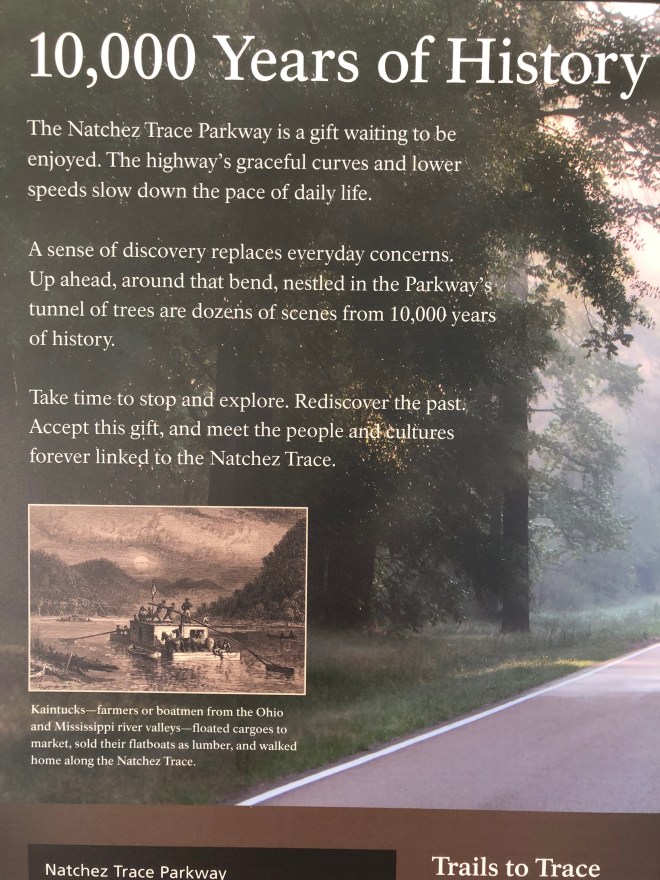
 Kim's journey